Stop guessing, start building
Generate text, stream, and get structured output — with one SDK for all providers. No more copy-pasting from ChatGPT.
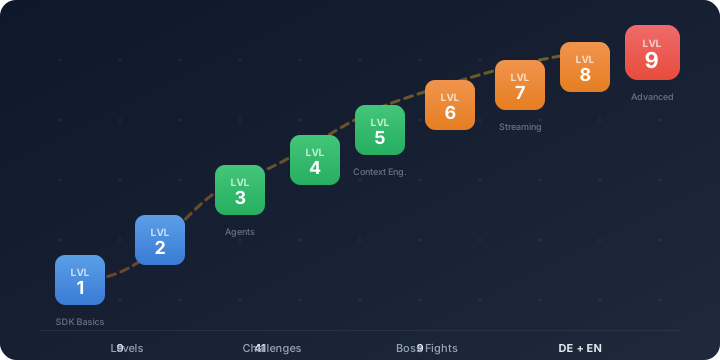
You prompt better than most. But when it comes to integrating AI programmatically — SDK, agents, tool calling, streaming — things get quiet. The problem isn’t a lack of talent. It’s a missing learning path.
Vibe Coding means: let an LLM generate code, paste it in, hope it works. No debugging, no evaluation, no understanding of the mechanics. The result: fragile applications that fail in production.
AI Engineering is the opposite: you understand how LLMs work. You measure quality instead of guessing. You build guardrails, track costs, and test systematically. Verify, don’t trust. This course takes you from one to the other.
Stop guessing, start building
Generate text, stream, and get structured output — with one SDK for all providers. No more copy-pasting from ChatGPT.
Build AI that takes action
Tool calling, MCP servers, agent loops — your AI doesn’t just answer, it does things.
Prove your AI works
Evals, LLM-as-Judge, observability with Langfuse — don’t ship and pray, measure and know.
Ship to real users with confidence
Streaming UIs, guardrails, model routing — production patterns that don’t break at scale.
Each level follows a fixed rhythm:
1. Briefing
Skill tree, learning objectives and a clear overview.
2. Challenges
6 steps: THINK, OVERVIEW, WHY, WALKTHROUGH, TRY, COMBINE.
3. Boss Fight
Combine all building blocks in one project — no solution provided.
4. Level Complete
Summary and preview of the next level.
| Level | Topic | What you’ll build |
|---|---|---|
| 1 | AI SDK Basics | generateText, streamText, structured output |
| 2 | LLM Fundamentals | Tokens, usage tracking, context windows |
| 3 | Agents & MCP | Tool calling, MCP servers, agent loops |
| 4 | Persistence | Chat history, DB persistence, validation |
| 5 | Context Engineering | Prompting, RAG, chain of thought |
| 6 | Evals | Evalite, LLM-as-Judge, Langfuse |
| 7 | Streaming | Custom data parts, stream transforms |
| 8 | Workflows | Pipelines, streaming to frontend |
| 9 | Advanced Patterns | Guardrails, model router, research workflow |
This is you
TypeScript dev who wants to integrate AI into real projects. “Vibe Coder” who wants to systematically understand what happens under the hood.
What you need
Node.js 20+, basic TypeScript knowledge and an API key (Anthropic, OpenAI or Google).
Time commitment: ~25-50 hours at your own pace. At 2-4 hours per week, about 3 months for all 9 levels. Each level also works standalone.
No. The course starts from zero and builds up systematically. You should know TypeScript and have used an API before — that’s it. Machine learning theory is not required.
Any provider supported by the Vercel AI SDK works: Anthropic (Claude), OpenAI, or Google (Gemini). The SDK abstracts the differences, so you can switch anytime. Most challenges work with any provider.
No. Prompt engineering is one topic in Level 5. This course covers the full stack: SDK integration, tool calling, agents, streaming, evaluation, persistence, and production patterns. You write real code, not just prompts.
Yes. Each level works standalone. Check the Roadmap to see what each level covers and jump to what interests you. That said, levels build on each other — Level 3 (Agents) assumes you know Level 1 (SDK Basics).
This course is built on the Vercel AI SDK v6.x (as of March 2026). APIs evolve — when in doubt, check the current docs at ai-sdk.dev. The principles and patterns remain stable even as APIs change.
Most AI courses teach you to prompt. Few teach you to build. This course exists because the gap between “I can use ChatGPT” and “I can ship an AI feature” is bigger than it looks — and there was no free, structured path to close it. Every challenge is tested, every concept linked to official sources. No filler, no fluff.