Boss Fight: Production-Ready AI System
The Scenario
Section titled “The Scenario”You’re building a production-ready AI system — the ultimate project that combines everything you’ve learned across 9 levels. The system takes a topic, autonomously researches it, selects the optimal model for each step, protects itself with guardrails, and delivers a quality-assured report.
Your system should feel like this:
[Input Guard] "Edge Computing Trends" — Injection Check: OK, PII Check: OK
[Phase 1: Research] Routing: gemini-flash (Research = einfache Suche)  Iteration 1: search("Edge Computing Vorteile 2026") — 312 Tokens  Iteration 2: search("Edge Computing vs Cloud Computing") — 287 Tokens  Iteration 3: Fertig (finishReason: stop)[Phase 1] 3 Iterationen, 1.041 Tokens, Abbruch: complete
[Phase 2: Summarize] Routing: claude-sonnet (Analyse = komplex)  5 Kernaussagen generiert — 423 Tokens
[Phase 3: Format] Routing: claude-sonnet (Formatierung = komplex)  Streaming Report...  "Edge Computing hat sich als Schluessel-Technologie etabliert..."[Phase 3] 891 Tokens
[Output Guard] Laenge: OK (2.847 Zeichen), Format: OK
[Quality Compare] Gleichen Prompt an 2 Modelle → Judge Score: 8/10
[Stats] Pipeline: 3.2s, 2.355 Tokens, geschaetzte Kosten: $0.023
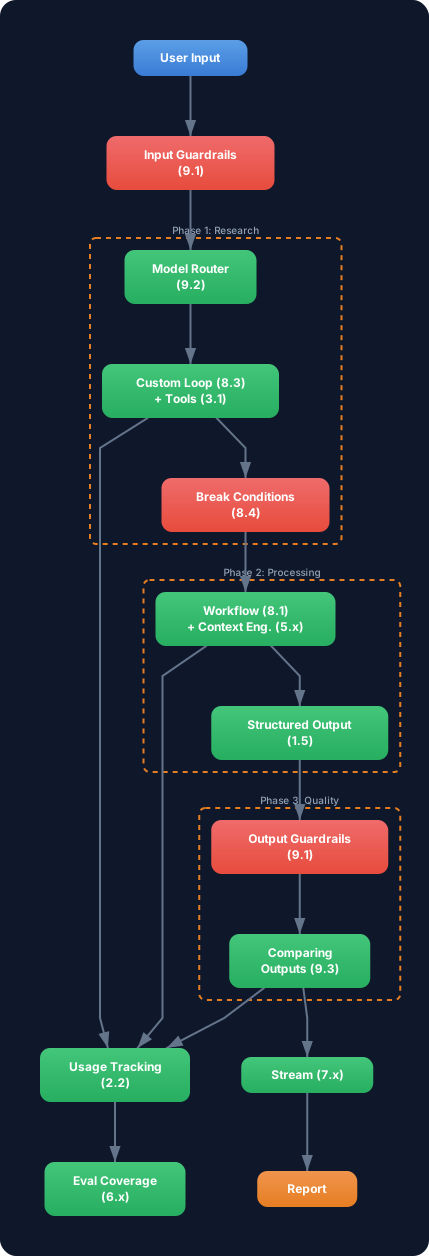
This project connects all 9 levels:
Requirements
Section titled “Requirements”-
Input Guardrails (Challenge 9.1) — Check every user input for prompt injection and PII before the pipeline starts. Invalid inputs are rejected with a clear error message.
-
Model Router (Challenge 9.2) — Use the optimal model for each phase of the pipeline. Research: cheap flash model. Analysis and formatting: powerful Sonnet/Opus model. Classification: smallest available model.
-
Research Loop (Level 3 + Level 8) — A custom agent loop with at least one tool (search). The loop has three break conditions: Max Iterations (5), Timeout (30s), Cost Guard (5,000 tokens). The agent decides on its own when enough research is done.
-
Workflow (Level 8.1) — The processing phase chains at least 2 sequential
generateTextcalls. Output from Step N becomes input for Step N+1. Each step has its own system prompt with XML-structured Context Engineering (Level 5). -
Output Guardrails (Challenge 9.1) — Check the final report for length, format, and content. Empty or overly long outputs are caught.
-
Comparing Outputs (Challenge 9.3) — For the final report: Generate the summary with 2 different models in parallel and choose the better result (via a simple scorer or LLM-as-a-Judge).
-
Streaming (Level 7 + 8.2) — Stream the final report in real time. Send progress data parts for each phase of the pipeline. (Use
createDataStream+writeDataas in Challenge 8.2.) -
Usage Tracking (Level 2.2) — Track token usage per phase and total. Calculate estimated costs.
-
Structured Output (Level 1.5) — The report is returned as a typed object with a Zod schema (title, summary, key findings, conclusion).
-
Eval Coverage (Level 6) — Write at least 2 Evalite tests: one that checks whether the report has the expected sections, and one that evaluates the length of the summary.
Starter Code
Section titled “Starter Code”import { createDataStream, generateText, streamText, tool, Output } from 'ai';import { anthropic } from '@ai-sdk/anthropic';import { google } from '@ai-sdk/google';import { z } from 'zod';
// --- Schemas ---const ReportSchema = z.object({ title: z.string(), summary: z.string(), keyFindings: z.array(z.string()).min(3).max(7), conclusion: z.string(),});
// --- Guardrails ---// TODO: Input guardrails (injection, PII)// TODO: Output guardrails (length, format)
// --- Model Router ---// TODO: selectModel(phase: 'research' | 'analysis' | 'format' | 'classify')
// --- Tools ---// TODO: search tool
// --- Pipeline Phases ---// TODO: researchPhase(topic) — Custom Loop + Tools + Break Conditions// TODO: processingPhase(research, topic) — Workflow + Context Engineering + Structured Output// TODO: qualityPhase(report) — Output Guardrails + Comparing Outputs
// --- Main Pipeline ---// TODO: researchPipeline(topic) — Orchestrates all phases, streams progress, tracks costs
// --- Evals ---// TODO: evalite('research-pipeline', { ... })Evaluation Criteria
Section titled “Evaluation Criteria”Your Boss Fight is passed when:
- Input guardrails check for prompt injection and PII
- Model Router selects different models for Research vs. Analysis
- Research Loop uses a custom while loop with at least one tool
- At least 2 break conditions are implemented (Max Iterations + one more)
- Workflow chains at least 2 sequential
generateTextcalls - System prompts use XML structure (Context Engineering)
- Output guardrails check the final report
- Comparing Outputs generates with at least 2 models in parallel and selects the better result
- Token usage is tracked per phase and total
- At least one Evalite test checks pipeline quality
Hint 1: Pipeline Structure
Build the pipeline as an async function researchPipeline(topic: string) that executes all three phases sequentially. Each phase is its own function that returns a result object. At the end: collect statistics and return the report.
Hint 2: Model Router Integration
Create a selectModel function that takes the phase name as a parameter. Research gets a flash model, Analysis and Format get Sonnet. The router is called in each phase, not centrally — so each phase can get its optimal model.
Hint 3: Integrating Comparing Outputs
The comparison doesn’t have to run the entire pipeline twice. It’s sufficient to generate the summary with 2 models in parallel (Promise.all) in the processing phase and then choose the longer/better output. The research step only runs once.
Hint 4: Keep Evals Separate
Write the evals in a separate file. Import the pipeline function and test it with Evalite. One scorer checks whether keyFindings.length >= 3, another whether summary.length > 100. This keeps pipeline and tests cleanly separated.