Challenge 9.3: Comparing Outputs
How do you find out which model gives the best answer — without reading every answer yourself? And what if the “best” answer depends on the task?
OVERVIEW
Section titled “OVERVIEW”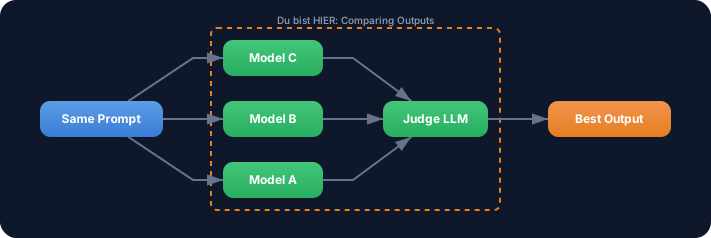
The same prompt goes to multiple models in parallel. All results are collected and evaluated by a judge LLM. The best result is returned.
Without systematic comparison: You choose a model based on gut feeling or marketing. “Claude is better” or “GPT-4o is faster” — without data. You don’t know whether a cheaper model would be sufficient for your use case.
With systematic comparison: You objectively test which model delivers the best answer for your specific task. You make data-driven model decisions. You find out where a flash model is sufficient and where you need a pro model.
WALKTHROUGH
Section titled “WALKTHROUGH”Layer 1: Parallel Calls with Promise.all
Section titled “Layer 1: Parallel Calls with Promise.all”The first step — send the same prompt to multiple models and collect all results:
import { generateText } from 'ai';import { anthropic } from '@ai-sdk/anthropic';import { openai } from '@ai-sdk/openai';import { google } from '@ai-sdk/google';
const prompt = 'Erklaere den Unterschied zwischen REST und GraphQL in 3 Saetzen.';
const models = [  { name: 'Claude Sonnet', model: anthropic('claude-sonnet-4-5-20250514') },  { name: 'GPT-4o', model: openai('gpt-4o') },  { name: 'Gemini Flash', model: google('gemini-2.5-flash') },];
// Call all models in parallelconst results = await Promise.all(  models.map(async ({ name, model }) => {    const start = Date.now();    const result = await generateText({ model, prompt });    return {      name,      text: result.text,      tokens: result.usage.totalTokens,      durationMs: Date.now() - start,    };  }),);
// Output resultsfor (const r of results) {  console.log(`\n--- ${r.name} (${r.tokens} Tokens, ${r.durationMs}ms) ---`);  console.log(r.text);}
Promise.all sends all requests simultaneously. The total duration is that of the slowest model, not the sum of all. You get text, token usage, and duration for each call.
Layer 2: Simple Comparison — Metrics
Section titled “Layer 2: Simple Comparison — Metrics”Before using an LLM as judge, you can automatically compare simple metrics:
function compareBasicMetrics(  results: Array<{ name: string; text: string; tokens: number; durationMs: number }>) {  console.log('\n=== Comparison ===\n');  console.log('| Model | Characters | Tokens | Duration | Tokens/Sec |');  console.log('|-------|------------|--------|----------|------------|');
  for (const r of results) {    const tokensPerSec = Math.round(r.tokens / (r.durationMs / 1000));    console.log(      `| ${r.name} | ${r.text.length} | ${r.tokens} | ${r.durationMs}ms | ${tokensPerSec} |`,    );  }
  // Shortest response (often more precise)  const shortest = results.reduce((a, b) => (a.text.length < b.text.length ? a : b));  console.log(`\nShortest response: ${shortest.name}`);
  // Fastest response  const fastest = results.reduce((a, b) => (a.durationMs < b.durationMs ? a : b));  console.log(`Fastest response: ${fastest.name}`);
  // Cheapest response  const cheapest = results.reduce((a, b) => (a.tokens < b.tokens ? a : b));  console.log(`Cheapest response: ${cheapest.name}`);}
compareBasicMetrics(results);
Simple metrics — length, speed, token usage — give an initial overview. But they say nothing about the quality of the response.
Layer 3: LLM-as-a-Judge
Section titled “Layer 3: LLM-as-a-Judge”For quality evaluation: A strong LLM evaluates the responses of the others. You know this pattern from Level 6.3:
import { generateText, Output } from 'ai';import { anthropic } from '@ai-sdk/anthropic';import { z } from 'zod';
const JudgmentSchema = z.object({  rankings: z.array(z.object({    model: z.string(),    score: z.number().min(1).max(10),    reasoning: z.string(),  })),  winner: z.string(),  summary: z.string(),});
async function judgeOutputs(  prompt: string,  results: Array<{ name: string; text: string }>,) {  const formattedOutputs = results    .map((r, i) => `<output model="${r.name}">\n${r.text}\n</output>`)    .join('\n\n');
  const judgment = await generateText({    model: anthropic('claude-sonnet-4-5-20250514'),     // ← Strong model as judge    system: `Du bist ein objektiver Qualitaets-Reviewer.Bewerte die folgenden LLM-Outputs nach:1. Korrektheit — Sind die Fakten richtig?2. Praezision — Ist die Antwort auf den Punkt?3. Verstaendlichkeit — Ist die Erklaerung klar?Vergib Scores von 1-10 und begruende Deine Bewertung.`,    prompt: `<task>${prompt}</task>\n\n${formattedOutputs}`,    output: Output.object({ schema: JudgmentSchema }),  });
  return judgment.output;}
// Usageconst judgment = await judgeOutputs(prompt, results);console.log('\n=== LLM-as-a-Judge ===\n');console.log(`Winner: ${judgment.winner}`);console.log(`Summary: ${judgment.summary}`);for (const r of judgment.rankings) {  console.log(`\n${r.model}: ${r.score}/10`);  console.log(`  ${r.reasoning}`);}
The judge receives the original task and all outputs. Through the Zod schema, the evaluation is structured — score, reasoning, and winner. Important: The judge should be a strong model, ideally not one of the models being evaluated.
Note: In this example we use Sonnet as both judge and one of the evaluated models — in production you’d use a stronger model (e.g., Opus) as judge that isn’t being evaluated itself.
Layer 4: Systematic Comparison with Evals
Section titled “Layer 4: Systematic Comparison with Evals”For repeatable comparisons, use an eval framework like Evalite from Level 6:
import { evalite } from 'evalite';import { generateText } from 'ai';import { anthropic } from '@ai-sdk/anthropic';import { openai } from '@ai-sdk/openai';import { google } from '@ai-sdk/google';
// Run eval for each model separatelyconst modelsToCompare = [  { name: 'claude-sonnet', model: anthropic('claude-sonnet-4-5-20250514') },  { name: 'gpt-4o', model: openai('gpt-4o') },  { name: 'gemini-flash', model: google('gemini-2.5-flash') },];
for (const { name, model } of modelsToCompare) {  evalite(`compare-${name}`, {    data: async () => [      { input: 'Erklaere Promises in 2 Saetzen.', expected: 'Promise' },      { input: 'Was ist der Unterschied zwischen let und const?', expected: 'const' },      { input: 'Erklaere async/await.', expected: 'await' },    ],    task: async (input) => {      const result = await generateText({ model, prompt: input });      return result.text;    },    scorers: [      // Check if the expected term appears      (output, expected) => {        const contains = output.toLowerCase().includes(expected.toLowerCase());        return { score: contains ? 1 : 0, name: 'contains-keyword' };      },      // Check conciseness (shorter responses = higher)      (output) => {        const score = Math.max(0, 1 - output.length / 2000);        return { score, name: 'conciseness' };      },    ],  });}
With Evalite you get reproducible results across multiple test cases. You can systematically benchmark models for your specific use case — not by general benchmarks, but by your requirements.
Task: Call 3 models in parallel, compare the results by length and a simple keyword scorer.
Create compare-outputs.ts and run with npx tsx compare-outputs.ts.
import { generateText } from 'ai';import { anthropic } from '@ai-sdk/anthropic';import { openai } from '@ai-sdk/openai';import { google } from '@ai-sdk/google';
const prompt = 'Erklaere den Unterschied zwischen var, let und const in JavaScript in maximal 3 Saetzen.';const expectedKeywords = ['var', 'let', 'const', 'scope', 'block'];
// TODO 1: Define an array with 3 models (name + model)
// TODO 2: Call all 3 in parallel with Promise.all
// TODO 3: Compare the results://   - How many expectedKeywords appear in each response?//   - How long is each response (characters)?//   - How many tokens did each response use?
// TODO 4: Determine the "winner" based on://   - Most keywords = highest quality//   - On tie: shorter response wins
Checklist:
- 3 models called in parallel with
Promise.all - Keyword count calculated for each response
- Length and token usage compared
- Winner determined and justified
- Results displayed in a clear format
Show solution
import { generateText } from 'ai';import { anthropic } from '@ai-sdk/anthropic';import { openai } from '@ai-sdk/openai';import { google } from '@ai-sdk/google';
const prompt =  'Erklaere den Unterschied zwischen var, let und const in JavaScript in maximal 3 Saetzen.';const expectedKeywords = ['var', 'let', 'const', 'scope', 'block'];
const models = [  { name: 'Claude Sonnet', model: anthropic('claude-sonnet-4-5-20250514') },  { name: 'GPT-4o', model: openai('gpt-4o') },  { name: 'Gemini Flash', model: google('gemini-2.5-flash') },];
// Call in parallelconst results = await Promise.all(  models.map(async ({ name, model }) => {    const start = Date.now();    const result = await generateText({ model, prompt });    const text = result.text;
    // Keyword scoring    const keywordCount = expectedKeywords.filter(kw =>      text.toLowerCase().includes(kw.toLowerCase()),    ).length;
    return {      name,      text,      tokens: result.usage.totalTokens,      durationMs: Date.now() - start,      keywordCount,      charCount: text.length,    };  }),);
// Output resultsconsole.log('=== Comparison ===\n');console.log('| Model | Keywords | Characters | Tokens | Duration |');console.log('|-------|----------|------------|--------|----------|');
for (const r of results) {  console.log(    `| ${r.name} | ${r.keywordCount}/${expectedKeywords.length} | ${r.charCount} | ${r.tokens} | ${r.durationMs}ms |`,  );}
// Determine winnerconst sorted = [...results].sort((a, b) => {  if (b.keywordCount !== a.keywordCount) return b.keywordCount - a.keywordCount;  return a.charCount - b.charCount; // On tie: shorter response wins});
console.log(`\nWinner: ${sorted[0].name} (${sorted[0].keywordCount} keywords, ${sorted[0].charCount} characters)`);
// Show responsesfor (const r of results) {  console.log(`\n--- ${r.name} ---`);  console.log(r.text);}
Explanation: Promise.all sends all requests in parallel — the total duration is that of the slowest model. The keyword scorer counts how many expected terms appear in the response. On a tie, the shorter response wins, because conciseness was required in the task (“maximum 3 sentences”).
Expected output (approximate):=== Comparison ===
| Model | Keywords | Characters | Tokens | Duration ||-------|----------|------------|--------|----------|| Claude Sonnet | 5/5 | 312 | 198 | 1.2s || GPT-4o | 4/5 | 287 | 176 | 0.9s || Gemini Flash | 5/5 | 256 | 143 | 0.6s |
Winner: Gemini Flash (5 keywords, 256 characters)
COMBINE
Section titled “COMBINE”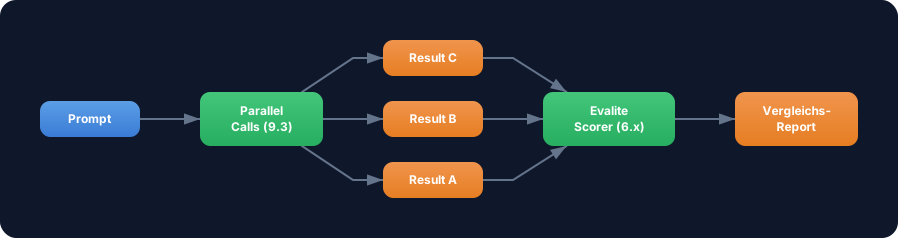
Exercise: Combine Comparing Outputs with the eval framework from Level 6. Instead of a one-time comparison:
- Define 5 test prompts for your use case (e.g., TypeScript explanations)
- Define 2 scorers — a keyword scorer and a length scorer
- Run all 3 models across all 5 prompts with Evalite
- Compare the results — which model wins on average?
The result is a data-driven report that tells you: “For TypeScript explanations, Model X is the best.” This is the foundation for the Model Router from Challenge 9.2.
Optional Stretch Goal: Implement LLM-as-a-Judge as an Evalite scorer. Use a strong model that rates the outputs on a scale of 1-10 and provides reasoning.