Challenge 8.1: Workflow
What if a task is too complex for a single LLM call — e.g., researching, summarizing, and formatting? Would you pack everything into one prompt, or split the task up?
OVERVIEW
Section titled “OVERVIEW”
A workflow chains multiple generateText calls. The output of Step 1 becomes the input of Step 2. Each step has its own prompt, its own role — and can be tested individually.
Without workflows: A massive prompt that has to research, summarize, and format all at once. Hard to debug — if the result is bad, you don’t know which sub-step failed. No intermediate results, no step-by-step testing.
With workflows: Specialized steps, each with its own system prompt. You can test Step 2 in isolation by giving it a fixed input. You see intermediate results after each step. And if Step 3 delivers poor results, you know: the problem is in the format prompt, not the research.
WALKTHROUGH
Section titled “WALKTHROUGH”Layer 1: The Simplest Workflow
Section titled “Layer 1: The Simplest Workflow”Three generateText calls in sequence. The output of Step N becomes the input of Step N+1:
import { generateText } from 'ai';import { anthropic } from '@ai-sdk/anthropic';
const model = anthropic('claude-sonnet-4-5-20250514');
// Step 1: Researchconst research = await generateText({  model,  system: 'Du bist ein Research-Assistent. Sammle Fakten und Daten zum Thema.',  prompt: 'Recherchiere die aktuellen Trends im Bereich Edge Computing.',});
console.log('--- Step 1: Research ---');console.log(research.text);
// Step 2: Summarizeconst summary = await generateText({  model,  system: 'Du bist ein Analyst. Fasse die folgenden Recherche-Ergebnisse in 3-5 Kernaussagen zusammen.',  prompt: research.text,  // ← Output from Step 1 becomes input of Step 2});
console.log('--- Step 2: Summary ---');console.log(summary.text);
// Step 3: Formatconst email = await generateText({  model,  system: 'Du bist ein Business-Writer. Formatiere die Zusammenfassung als professionelle E-Mail an das Management-Team.',  prompt: summary.text,  // ← Output from Step 2 becomes input of Step 3});
console.log('--- Step 3: Formatted Email ---');console.log(email.text);
Three calls, three roles, three specialized outputs. The key point: each system prompt defines a different expertise. Step 1 gathers facts, Step 2 analyzes, Step 3 formats.
Layer 2: Encapsulating as a Function
Section titled “Layer 2: Encapsulating as a Function”To make the workflow reusable, we wrap it in a function:
import { generateText } from 'ai';import { anthropic } from '@ai-sdk/anthropic';
const model = anthropic('claude-sonnet-4-5-20250514');
async function contentPipeline(topic: string) {  // Step 1: Research  const research = await generateText({    model,    system: 'Du bist ein Research-Assistent. Sammle Fakten und Daten zum gegebenen Thema. Nenne konkrete Zahlen und Beispiele.',    prompt: `Recherchiere: ${topic}`,  });
  // Step 2: Summarize  const summary = await generateText({    model,    system: 'Du bist ein Analyst. Fasse die folgenden Informationen in maximal 5 praegnanten Kernaussagen zusammen. Jede Aussage in einem Satz.',    prompt: `Fasse zusammen:\n\n${research.text}`,  });
  // Step 3: Format as Email  const email = await generateText({    model,    system: 'Du bist ein Business-Writer. Formatiere den folgenden Inhalt als professionelle E-Mail. Betreff, Anrede, Kernpunkte, Gruss.',    prompt: `Formatiere als E-Mail an das Team:\n\n${summary.text}`,  });
  return {    research: research.text,    summary: summary.text,    email: email.text,    totalTokens:      research.usage.totalTokens +      summary.usage.totalTokens +      email.usage.totalTokens,  };}
// Executeconst result = await contentPipeline('Edge Computing Trends 2026');console.log(result.email);console.log(`\nTotal Tokens: ${result.totalTokens}`);
The function returns all intermediate results. This is important for debugging — if the email is bad, you check result.summary. If the summary is bad, you check result.research. Each layer debuggable on its own.
Layer 3: Token Tracking Across the Pipeline
Section titled “Layer 3: Token Tracking Across the Pipeline”A workflow with three steps consumes three times as many API calls as a single one. Token tracking matters:
async function trackedPipeline(topic: string) {  const steps: Array<{ name: string; tokens: number; duration: number }> = [];
  async function runStep(name: string, system: string, prompt: string) {    const start = Date.now();    const result = await generateText({ model, system, prompt });    steps.push({      name,      tokens: result.usage.totalTokens,      duration: Date.now() - start,    });    return result.text;  }
  const research = await runStep(    'research',    'Du bist ein Research-Assistent. Sammle Fakten zum Thema.',    `Recherchiere: ${topic}`,  );
  const summary = await runStep(    'summarize',    'Fasse die Informationen in 3-5 Kernaussagen zusammen.',    research,  );
  const formatted = await runStep(    'format',    'Formatiere als professionelle E-Mail.',    summary,  );
  // Log step statistics  for (const step of steps) {    console.log(`${step.name}: ${step.tokens} Tokens, ${step.duration}ms`);  }
  const totalTokens = steps.reduce((sum, s) => sum + s.tokens, 0);  const totalDuration = steps.reduce((sum, s) => sum + s.duration, 0);  console.log(`\nTotal: ${totalTokens} Tokens, ${totalDuration}ms`);
  return { result: formatted, steps };}
await trackedPipeline('Edge Computing Trends 2026');
The runStep helper function encapsulates the shared code: call generateText, measure tokens and duration, return the result. This reduces boilerplate and makes token tracking consistent.
Task: Build a 3-step content pipeline: research, summarize, translate (to English). Track tokens per step.
Create the file workflow.ts and run it with npx tsx workflow.ts.
import { generateText } from 'ai';import { anthropic } from '@ai-sdk/anthropic';
const model = anthropic('claude-sonnet-4-5-20250514');
// TODO 1: Define an async function contentPipeline(topic: string)
// TODO 2: Step 1 — Research//   system: 'Du bist ein Research-Assistent. Sammle Fakten zum Thema.'//   prompt: `Recherchiere: ${topic}`
// TODO 3: Step 2 — Summarize//   system: 'Fasse die Informationen in 3-5 Kernaussagen zusammen.'//   prompt: Output from Step 1
// TODO 4: Step 3 — Translate//   system: 'Translate the following German text to English. Keep it professional.'//   prompt: Output from Step 2
// TODO 5: Track tokens per step and print them at the end
// TODO 6: Call the pipeline// const result = await contentPipeline('Kuenstliche Intelligenz in der Medizin');
Checklist:
- 3 sequential
generateTextcalls implemented - Output of Step N becomes input of Step N+1
- Each step has its own
systemprompt - Token usage per step is logged
- Total token usage is calculated
Show solution
import { generateText } from 'ai';import { anthropic } from '@ai-sdk/anthropic';
const model = anthropic('claude-sonnet-4-5-20250514');
async function contentPipeline(topic: string) {  const steps: Array<{ name: string; tokens: number }> = [];
  // Step 1: Research (Deutsch)  const research = await generateText({    model,    system: 'Du bist ein Research-Assistent. Sammle Fakten und aktuelle Entwicklungen zum gegebenen Thema. Nenne konkrete Beispiele.',    prompt: `Recherchiere: ${topic}`,  });  steps.push({ name: 'research', tokens: research.usage.totalTokens });
  // Step 2: Summarize (Deutsch)  const summary = await generateText({    model,    system: 'Du bist ein Analyst. Fasse die folgenden Informationen in exakt 5 praegnanten Kernaussagen zusammen. Jede Aussage in einem Satz.',    prompt: `Fasse zusammen:\n\n${research.text}`,  });  steps.push({ name: 'summarize', tokens: summary.usage.totalTokens });
  // Step 3: Translate (Englisch)  const translated = await generateText({    model,    system: 'You are a professional translator. Translate the following German text to English. Keep the bullet-point structure and professional tone.',    prompt: `Translate to English:\n\n${summary.text}`,  });  steps.push({ name: 'translate', tokens: translated.usage.totalTokens });
  // Print statistics  for (const step of steps) {    console.log(`${step.name}: ${step.tokens} Tokens`);  }  const totalTokens = steps.reduce((sum, s) => sum + s.tokens, 0);  console.log(`\nTotal: ${totalTokens} Tokens`);
  return {    research: research.text,    summary: summary.text,    translated: translated.text,    totalTokens,  };}
const result = await contentPipeline('Kuenstliche Intelligenz in der Medizin');console.log('\n--- Result (English) ---');console.log(result.translated);
Expected output (approximate):
research: 342 Tokenssummarize: 187 Tokenstranslate: 156 Tokens
Total: 685 Tokens
--- Result (English) ---[Translated text appears here — varies depending on LLM response]
Explanation: Three specialized steps — each with its own role. Step 1 researches in German, Step 2 summarizes, Step 3 translates to English. Token usage is tracked per step. You can test each step individually by giving it a fixed input.
COMBINE
Section titled “COMBINE”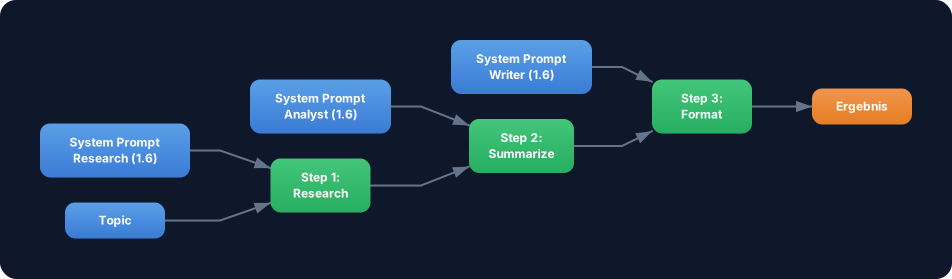
Exercise: Combine the workflow with system prompts from Level 1.6. Build a pipeline with three different roles:
- Step 1 — Researcher:
system: 'Du bist ein Experte fuer [Dein Thema]. Recherchiere gruendlich und nenne Zahlen und Quellen.' - Step 2 — Critic:
system: 'Du bist ein kritischer Reviewer. Pruefe die folgenden Aussagen auf Schwachstellen und Luecken. Benenne was fehlt.' - Step 3 — Writer:
system: 'Du bist ein erfahrener Autor. Schreibe einen ausgewogenen Artikel, der sowohl die Fakten als auch die Kritikpunkte integriert.'
Through the Critic step, the final article gains more substance than a simple research-to-format workflow.
Optional Stretch Goal: Add a 4th step that converts the finished article into structured metadata (title, summary, tags, reading time) using Output.object and a Zod schema. Use Output.object from Level 1.5 for this.