Challenge 6.4: Dataset Management
How many test cases do you need — and how do you know if they’re good enough? 3 examples that all look similar only test the normal case. What happens with edge cases, unexpected inputs, or empty entries?
OVERVIEW
Section titled “OVERVIEW”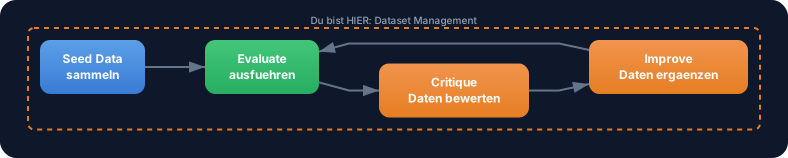
Dataset management is a cycle: You collect seed data, run evals, assess the quality of your test data, add missing cases, and evaluate again. The data gets better with each iteration.
Without good datasets: Your evals measure the wrong thing. 5 test cases that all come from the same category give you false confidence. The score says 0.95 — but on an edge case the LLM hallucinates. You don’t notice because the edge case isn’t in the dataset.
With good datasets: 20-50 diverse test cases cover normal cases, edge cases, and boundary cases. When the score says 0.85, you know it’s representative. You spot weaknesses early and can improve in a targeted way.
WALKTHROUGH
Section titled “WALKTHROUGH”Layer 1: Dataset as an async Function
Section titled “Layer 1: Dataset as an async Function”In Evalite you can define data as an async function. This allows dynamic loading — from files, APIs, or databases:
import { evalite } from 'evalite';
evalite('Chat Titles', {  data: async () => {    // Can load from a JSON file, query an API, etc.    return [      {        input: 'Hey, I need help with TypeScript Generics.',        expected: 'TypeScript Generics',      },      {        input: 'How do I configure ESLint for a React project?',        expected: 'ESLint React Setup',      },    ];  },  task: async (input) => { /* ... */ return ''; },  scorers: [],});
The async function is called on every eval run. This lets you load test data from external sources without hardcoding it.
Layer 2: Dataset Size and Diversity
Section titled “Layer 2: Dataset Size and Diversity”How many test cases do you need? The rule of thumb:
| Phase | Count | Purpose |
|---|---|---|
| Prototype | 5-10 | Quick feedback, check basic functionality |
| Development | 20-50 | Representative coverage, include edge cases |
| Production | 50-200+ | Statistically significant, all categories covered |
More important than the count is diversity. 50 similar test cases are worth less than 20 diverse ones:
data: async () => [  // Normal cases  { input: 'Explain React Hooks.', expected: 'React Hooks' },  { input: 'How does async/await work?', expected: 'Async/Await in JavaScript' },
  // Short inputs  { input: 'TypeScript?', expected: 'TypeScript' },  { input: 'help', expected: 'General Help' },
  // Long inputs  { input: 'I have a problem with my Next.js project. When I try to create an API route, I get a 500 error. The server starts, but the route doesn\'t respond. I\'m using the App Router architecture.', expected: 'Next.js API Route Error' },
  // Ambiguous inputs  { input: 'That doesn\'t work', expected: 'Troubleshooting' },  { input: 'Can you do that again?', expected: 'Repetition' },
  // Special characters and formatting  { input: 'What is O(n log n)?', expected: 'Algorithm Complexity' },  { input: 'Difference: map() vs forEach()?', expected: 'Array Methods Comparison' },
  // Empty or trivial inputs  { input: '', expected: 'Empty Input' },  { input: '   ', expected: 'Empty Input' },],
Layer 3: Systematically Covering Categories
Section titled “Layer 3: Systematically Covering Categories”Define categories for your dataset and make sure each one is covered:
// Dataset categories for a chat title generatorconst categories = {  technical: [    { input: 'How does Git Rebase work?', expected: 'Git Rebase' },    { input: 'What is a Docker Container?', expected: 'Docker Container' },  ],  conversational: [    { input: 'Hey, I need help!', expected: 'Help Request' },    { input: 'Thanks, that helped.', expected: 'Feedback' },  ],  edgeCases: [    { input: '', expected: 'Empty Input' },    { input: 'a', expected: 'Single Character' },    { input: '🚀🔥💡', expected: 'Emoji Input' },  ],  multilingual: [    { input: 'Comment faire du cafe?', expected: 'Coffee Question (FR)' },    { input: 'What is the meaning of life?', expected: 'Meaning Question (EN)' },  ],};
evalite('Chat Titles', {  data: async () => [    ...categories.technical,    ...categories.conversational,    ...categories.edgeCases,    ...categories.multilingual,  ],  task: async (input) => { /* ... */ return ''; },  scorers: [],});
Layer 4: Dataset Critiquing
Section titled “Layer 4: Dataset Critiquing”An advanced technique: Let an LLM evaluate the quality of your test data. “Are my test cases representative enough? What cases are missing?”
import { generateObject } from 'ai';import { openai } from '@ai-sdk/openai';import { z } from 'zod';
async function critiqueDataset(  dataset: Array<{ input: string; expected: string }>) {  const { object } = await generateObject({    model: openai('gpt-4o'),    prompt: `You are a QA expert reviewing a test dataset for a chat title generator.The system takes a user message as input and generates a short title.
Here is the current dataset:${JSON.stringify(dataset, null, 2)}
Analyze the dataset for:1. Coverage: Are important categories missing?2. Edge cases: Are boundary conditions tested?3. Diversity: Are the inputs diverse enough?4. Quality: Are the expected values reasonable?
Suggest specific test cases that should be added.`,    schema: z.object({      overallAssessment: z.string(),      missingCategories: z.array(z.string()),      suggestedTestCases: z.array(z.object({        input: z.string(),        expected: z.string(),        reason: z.string(),      })),      qualityScore: z.number().min(0).max(1),    }),  });
  return object;}
The result tells you which categories are missing and suggests specific test cases. You review the suggestions, adopt the useful ones, and run the evals again.
Layer 5: Versioning Your Dataset
Section titled “Layer 5: Versioning Your Dataset”Your dataset changes over time. Version it like code:
export const chatTitleDataset = [  { input: 'Explain React Hooks.', expected: 'React Hooks' },  // ...];
// Version informationexport const datasetMeta = { version: '1.0', lastUpdated: '2026-03-08', totalCases: 25, categories: ['technical', 'conversational', 'edgeCases'],};import { evalite } from 'evalite';import { chatTitleDataset } from './datasets/chat-titles-v1';
evalite('Chat Titles', { data: async () => chatTitleDataset, task: async (input) => { /* ... */ return ''; }, scorers: [],});This way you can compare later: Did the score change with dataset v2?
Task: Create a dataset for a chat title generator with at least 15 test cases from different categories.
Create the file dataset.eval.ts and run it with pnpm eval:dev.
import { evalite } from 'evalite';import { Levenshtein } from 'autoevals';
// TODO 1: Create a dataset with at least 15 test cases//   Categories://   - Technical (at least 4 cases)//   - Conversational (at least 3 cases)//   - Edge Cases (at least 3 cases): empty strings, special characters, very long inputs//   - Multilingual (at least 2 cases)//   - Ambiguous (at least 3 cases)
// TODO 2: Define an evalite() with://   - data: Your dataset//   - task: Simulated title generation (e.g., the first 5 words of the input)//   - scorers: [Levenshtein]
// TODO 3: Think about: What categories are still missing?//   What edge cases haven't you covered?
Checklist:
- At least 15 test cases
- At least 4 different categories
- Edge cases included (empty input, special characters, long input)
- Expected values are realistic titles (short, descriptive)
- No duplicate or nearly identical test cases
Show solution
import { evalite } from 'evalite';import { Levenshtein } from 'autoevals';
const chatTitleDataset = [  // Technical (5)  { input: 'How does Git Rebase work?', expected: 'Git Rebase' },  { input: 'Explain React useEffect with cleanup.', expected: 'React useEffect Cleanup' },  { input: 'What is the difference between REST and GraphQL?', expected: 'REST vs GraphQL' },  { input: 'Help with TypeScript Generics and multiple constraints.', expected: 'TypeScript Generics' },  { input: 'Docker container won\'t start — port already in use.', expected: 'Docker Port Conflict' },
  // Conversational (3)  { input: 'Hey, can you help me?', expected: 'Help Request' },  { input: 'Thanks, that worked great!', expected: 'Positive Feedback' },  { input: 'I don\'t understand, can you explain it again?', expected: 'Repeat Explanation' },
  // Edge Cases (4)  { input: '', expected: 'Empty Message' },  { input: '???', expected: 'Unclear Request' },  { input: 'a', expected: 'Minimal Input' },  { input: 'I have a really complicated problem with my Next.js project that uses the App Router and the API routes aren\'t working because the server returns a 500 error when I try to send a POST request with a JSON body that contains nested objects and TypeScript throws errors.', expected: 'Next.js API Route Error' },
  // Multilingual (2)  { input: 'How do I deploy to Vercel?', expected: 'Vercel Deployment' },  { input: 'Comment configurer ESLint?', expected: 'ESLint Configuration' },
  // Ambiguous (3)  { input: 'That doesn\'t work.', expected: 'Troubleshooting' },  { input: 'Do that again.', expected: 'Repetition' },  { input: 'Continue.', expected: 'Continuation' },];
evalite('Chat Titles', {  data: async () => chatTitleDataset,  task: async (input) => {    // Simulated title generation: first 5 words or fallback    if (!input.trim()) return 'Empty Message';    const words = input.split(' ').slice(0, 5).join(' ');    return words.length > 50 ? words.slice(0, 50) : words;  },  scorers: [Levenshtein],});
Explanation: The Levenshtein scores will be low because the simulated task only takes the first 5 words — not the ideal title. That’s the point: With the dataset you can see WHERE the task fails and iteratively improve. Missing categories could include: code snippets as input, URLs, questions in non-Latin scripts.
COMBINE
Section titled “COMBINE”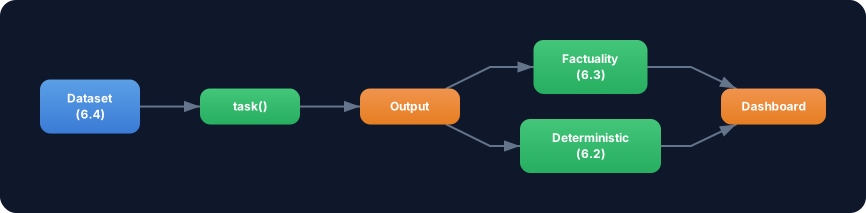
Exercise: Use your chat title dataset (6.4) with the scorers from Challenge 6.2 and 6.3.
- Take your dataset from the TRY exercise
- Fill the
taskwith a real LLM call (system prompt: “Generate a short, descriptive title for this chat message. Max 50 characters. Only the title, nothing else.”) - Scorer 1:
containsKeyword(from 6.2) — does the title contain a keyword? - Scorer 2:
Factuality(from 6.3) — is the title factually appropriate? - Check: For which categories does the
taskfail?
Optional Stretch Goal: Run critiqueDataset from Layer 4 on your dataset. Adopt 3 of the suggested test cases and compare the scores before/after.