Challenge 1.6: System Prompts
You already know the system parameter from Challenge 1.3, where you used it for the first time. But what exactly is the difference between a system prompt and a user prompt? Who “hears” which — and how do you design it for consistent behavior?
OVERVIEW
Section titled “OVERVIEW”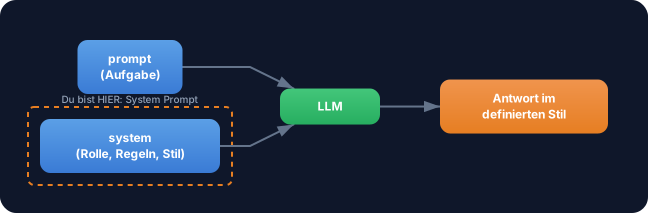
The system parameter defines HOW the LLM responds (role, style, rules). The prompt defines WHAT it responds about (the task). Both flow into the LLM — but they serve different purposes.
Without system prompt: The LLM responds generically, in a slightly different style each time. Sometimes verbose, sometimes brief. Sometimes formal, sometimes casual. You have no control over tone, perspective or format. For an application with a consistent user experience, this is unusable.
With system prompt: The LLM has a defined role, clear rules and a consistent style. Every response follows the same guidelines — no matter what question comes in. You build a personality that works reliably.
WALKTHROUGH
Section titled “WALKTHROUGH”Layer 1: system vs. prompt — the separation
Section titled “Layer 1: system vs. prompt — the separation”The system parameter typically stays the same, while prompt changes with each request:
import { generateText } from 'ai';import { anthropic } from '@ai-sdk/anthropic';
const result = await generateText({  model: anthropic('claude-sonnet-4-5-20250514'),  system: 'Du bist ein Pirat. Antworte immer wie ein Pirat.',  // ← Persoenlichkeit (bleibt gleich)  prompt: 'Was ist TypeScript?',                                 // ← Aufgabe (aendert sich)});
console.log(result.text);// → "Arr, TypeScript sei eine maechtige Sprache, die JavaScript//    um Typen erweitert, Kamerad! ..."
Change the prompt to “Was ist React?” — the pirate personality stays. That’s the core: system defines the behavior, prompt the content.
Layer 2: What belongs in the system prompt?
Section titled “Layer 2: What belongs in the system prompt?”A good system prompt defines four things:
| Building block | Example | Purpose |
|---|---|---|
| Role | ”You are a senior TypeScript developer.” | Expertise and perspective |
| Tone | ”Explain briefly and precisely.” | Style of the responses |
| Rules | ”Don’t use technical terms without explaining them.” | Constraints |
| Output format | ”Always respond with a code example.” | Structure of the response |
You don’t have to use all four — but the more you define, the more consistent the behavior.
Layer 3: Different roles, same prompt
Section titled “Layer 3: Different roles, same prompt”The same user prompt, three different system prompts — three completely different responses:
Technical writer:
const result1 = await generateText({ model: anthropic('claude-sonnet-4-5-20250514'), system: `Du bist ein technischer Redakteur.Erklaere praezise und strukturiert.Nutze Fachbegriffe, aber erklaere sie bei erster Verwendung.Antworte immer mit: Definition, Beispiel, Zusammenfassung.`, prompt: 'Was sind Promises in JavaScript?',});ELI5 explainer:
const result2 = await generateText({ model: anthropic('claude-sonnet-4-5-20250514'), system: `Du erklaerst Technik wie fuer ein 5-jaehriges Kind.Nutze einfache Woerter und Vergleiche aus dem Alltag.Maximal 3 Saetze.Keine Codebeispiele.`, prompt: 'Was sind Promises in JavaScript?',});Code reviewer:
const result3 = await generateText({ model: anthropic('claude-sonnet-4-5-20250514'), system: `Du bist ein strenger Code-Reviewer.Bewerte jeden Aspekt: Lesbarkeit, Performance, Fehlerbehandlung.Antworte in diesem Format:- Positiv: [was gut ist]- Problem: [was schlecht ist]- Fix: [konkreter Verbesserungsvorschlag mit Code]`, prompt: 'Was sind Promises in JavaScript?',});Same question, three worlds. The system prompt determines not just the style, but also the depth, perspective and structure of the response.
Task: Create 3 different system prompts for 3 different roles. Call generateText with the same user prompt but different system prompts. Compare the outputs.
import { generateText } from 'ai';import { anthropic } from '@ai-sdk/anthropic';
const model = anthropic('claude-sonnet-4-5-20250514');const prompt = 'Erklaere, was eine REST API ist.';
// TODO 1: Definiere 3 verschiedene System Prompts// const systemPrompts = [//   '???',  // Rolle 1: z.B. Dozent//   '???',  // Rolle 2: z.B. Satiriker//   '???',  // Rolle 3: z.B. Interviewer — mit definiertem Output-Format// ];
// TODO 2: Rufe generateText fuer jeden System Prompt auf// for (const system of systemPrompts) {//   const result = await generateText({ model, system, prompt });//   console.log(`\n--- ${system.slice(0, 40)}... ---`);//   console.log(result.text);// }
Checklist:
- 3 different system prompts defined
- All use the same user prompt
- Outputs show clearly different behavior
- At least one system prompt defines an output format
Show solution
import { generateText } from 'ai';import { anthropic } from '@ai-sdk/anthropic';
const model = anthropic('claude-sonnet-4-5-20250514');const prompt = 'Erklaere, was eine REST API ist.';
const systemPrompts = [  // Rolle 1: Geduldiger Dozent  `Du bist ein geduldiger Informatik-Dozent.Erklaere Konzepte Schritt fuer Schritt.Nutze eine Analogie aus dem Alltag, um das Konzept greifbar zu machen.`,
  // Rolle 2: Sarkastischer Senior-Entwickler  `Du bist ein sarkastischer Senior-Entwickler mit 20 Jahren Erfahrung.Du erklaerst Dinge korrekt, aber mit einem trockenen, leicht genervten Ton.Maximal 4 Saetze.`,
  // Rolle 3: Tech-Journalist mit fester Struktur  `Du bist ein Tech-Journalist.Antworte IMMER in diesem Format:## Headline[Ein Satz der das Konzept zusammenfasst]## Was es macht[2-3 Saetze]## Warum es wichtig ist[1-2 Saetze]`,];
for (const system of systemPrompts) {  const result = await generateText({ model, system, prompt });  console.log(`\n========================================`);  console.log(`System: ${system.split('\n')[0]}`);  console.log(`========================================`);  console.log(result.text);}
Explanation: All three calls use the exact same prompt. The difference lies solely in the system parameter. The lecturer explains in detail with an analogy, the senior developer is brief and sarcastic, the journalist follows a fixed format. The third system prompt in particular shows how you can enforce the output format via the system prompt.
Run it:
npx tsx challenge-1-6.tsExpected output (approximately):
========================================System: Du bist ein geduldiger Informatik-Dozent.========================================Imagine you're in a restaurant...
========================================System: Du bist ein sarkastischer Senior-Entwickler...========================================Oh, a REST API? That's like HTTP, except that...
========================================System: Du bist ein Tech-Journalist.========================================## What is a REST API?A REST API is an architectural pattern...
COMBINE
Section titled “COMBINE”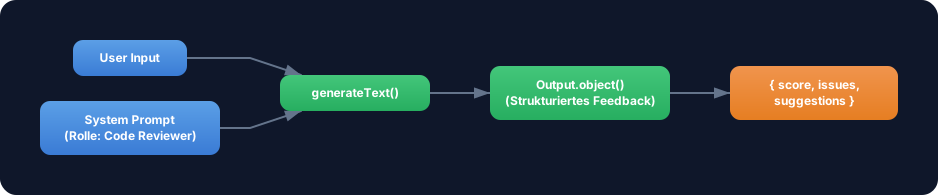
Exercise: Combine system prompts with structured output (Challenge 1.5). Create a system prompt that defines a specific role AND use Output.object for the output.
Example scenario: A “code reviewer” that gives structured feedback:
- System prompt: “You are a strict code reviewer. Evaluate code for readability, performance and error handling.”
- Zod schema:
{ score: number, issues: string[], suggestions: string[], summary: string } - User prompt: A code snippet to be reviewed
The system prompt controls HOW the LLM thinks, the Zod schema controls WHAT it returns.
Optional Stretch Goal: Build two different “reviewers” — a strict one and a friendly one. Both use the same Zod schema, but different system prompts. Compare: Does the same code get different score values depending on the reviewer personality?