Autonomy Levels
Context
Section titled “Context”Your competitor just launched a “fully autonomous AI agent.” Your CEO asks: “Why isn’t our agent autonomous too?” The honest answer: because autonomy isn’t a feature you toggle on. It’s a spectrum — and the right level depends on risk, domain, and the trust you’ve built.
The analogy to autonomous driving helps: nobody would put a Level 5 self-driving car on the road without years of validation. Similar principles apply to AI agents — with an important nuance: some AI errors are reversible (git revert, undo), while car crashes are not. But not all AI actions can be undone — sent emails, executed transactions, or published content can cause irreversible damage.
Concept
Section titled “Concept”The Autonomy Spectrum
Section titled “The Autonomy Spectrum”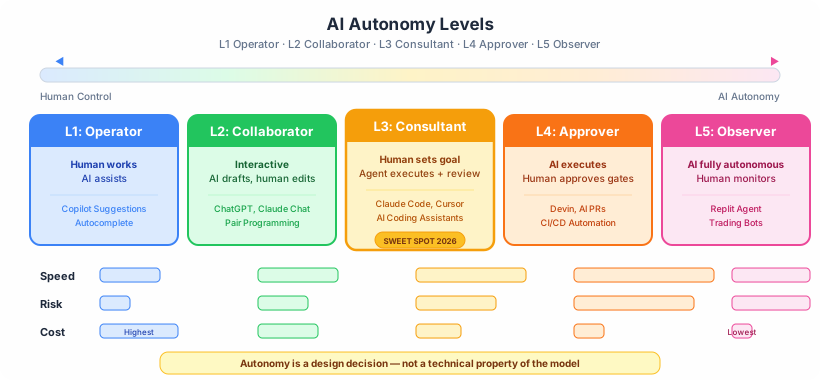
AI agent autonomy exists on a spectrum defined by the degree of human involvement. The most-cited framework (Feng et al., 2025) defines five levels:
| Level | Human Role | Agent Behavior | Product Example |
|---|---|---|---|
| L1: Operator | Human does the work, AI assists | Suggestions, autocomplete | GitHub Copilot inline suggestions |
| L2: Collaborator | Human and AI work together interactively | AI drafts, human edits | ChatGPT, Claude chat |
| L3: Consultant | Human sets goal, reviews result | Agent plans and executes, human reviews | Claude Code (default), Cursor |
| L4: Approver | AI executes, human approves at checkpoints | Autonomous work with approval gates | Devin, CI/CD with AI-generated PRs |
| L5: Observer | AI executes fully, human monitors | Fully autonomous with dashboard | Replit Agent, automated trading bots |
Autonomy Is a Design Decision
Section titled “Autonomy Is a Design Decision”Autonomy is not an inherent technical property of the model. It is shaped by:
- UI constraints — confirmation dialogs, approval gates, read-only modes
- Scope limits — which tools the agent can access, which actions are permitted
- Guardrails — content filters, budget caps, rate limits
- Escalation triggers — confidence thresholds, error counts, sensitive-topic detection
When to Increase Autonomy
Section titled “When to Increase Autonomy”Increasing autonomy should be driven by evidence, not ambition:
| Signal | Action |
|---|---|
| Approval rate above 95% over 30 days | Consider auto-approving that action class |
| Error rate below 1% for a task category | Candidate for reduced oversight |
| Users consistently skip the review step | The review step may be unnecessary friction |
| Regulatory requirement exists | Do NOT increase autonomy regardless of metrics |
| High output variance observed | Decrease autonomy, add human checkpoints |
Risk Profile by Level
Section titled “Risk Profile by Level”| Level | Speed | Quality Risk | Safety Risk | Cost |
|---|---|---|---|---|
| L1 | Slowest | Lowest | Lowest | Highest (human labor) |
| L3 | Fast | Moderate | Moderate | Moderate |
| L5 | Fastest | Highest | Highest | Lowest (if it works) |
Framework
Section titled “Framework”The Autonomy Decision Ladder — run through for every new AI feature:
| Question | Answer | Recommendation |
|---|---|---|
| What is the cost of an error? | High (financial, safety, legal) | L1-L2 |
| Is the action reversible? | Yes | L3-L4 possible |
| Does regulation require human approval? | Yes | L2-L3 maximum |
| Is the task well-defined and repetitive? | Yes | Candidate for higher autonomy |
| Do we have enough validation data? | No | Start at L1-L2 |
| Can we implement gradual escalation? | Yes | Start low, increase with evidence |
Scenario
Section titled “Scenario”You’re the PM for a fintech startup. Your product is an AI bookkeeping agent that processes invoices, categorizes them, and prepares payments. Three user segments:
Freelancers (5,000 users): Average 20 invoices/month, amounts under 500 euros, simple categorization. Beta approval rate: 97%.
SMBs (800 users): Average 200 invoices/month, amounts up to 50,000 euros, complex cost centers. Beta approval rate: 89%.
Enterprise (50 users): Average 2,000 invoices/month, regulatory requirements (local GAAP/IFRS), four-eyes principle mandated. Beta approval rate: 91%.
The question: Which autonomy level for which segment?
Decide
Section titled “Decide”How would you decide?
The best decision: Different levels per segment.
-
Freelancers → L4 (Approver): 97% approval rate, low amounts, simple structure. Agent categorizes and prepares payment, user approves via batch approval. High time savings at low risk.
-
SMBs → L3 (Consultant): 89% approval rate is too low for L4. Agent categorizes and suggests, user reviews each entry individually. Upgrade to L4 as approval rate improves.
-
Enterprise → L2-L3 (Collaborator/Consultant): Four-eyes principle is mandated by regulation. Even at 99% approval rate, the agent cannot book autonomously. Agent prepares, first human checks, second human approves. L3 for preparation, L2 for final sign-off.
Why:
- Keeping freelancers at L2 wastes the product-market fit — they want time savings
- Setting SMBs to L4 with 89% approval rate means 11% error rate on amounts up to 50,000 euros
- Enterprise CANNOT go higher than L3, regardless of model quality — regulation is the constraint
What many get wrong: One autonomy level for all users. Power users get frustrated, risk-sensitive users lose trust.
Reflect
Section titled “Reflect”Autonomy is not a goal but a design parameter. The right question isn’t “How autonomous can we get?” but “How autonomous should we be for this user in this context?”
- L3 is the sweet spot for most B2B products in 2026 — fast enough to be valuable, controlled enough to be trustworthy
- Autonomy must be adjustable per user segment, task type, and domain
- The path to L5 runs through months of L3-L4 evidence — there are no shortcuts
Sources: Knight First Amendment Institute — Levels of Autonomy for AI Agents (Feng et al., 2025), MIT AI Agent Index 2025, Sema4.ai — Five Levels of Agentic Automation (2025)