Multi-Agent Systems
Context
Section titled “Context”Your team has built an AI coding agent that works well: it reads code, suggests changes, writes tests. But now management wants more — the agent should also handle deployments, write documentation, and perform code reviews. Your engineering team proposes: “We need multiple specialized agents.”
Sounds logical. But multi-agent systems aren’t an upgrade you just bolt on. They’re an architecture decision with real tradeoffs. A 5-agent pipeline where each agent has 95% reliability delivers only ~77% end-to-end reliability (0.95^5). More agents don’t automatically mean better results.
Concept
Section titled “Concept”A multi-agent system (MAS) consists of multiple AI agents — each with a defined role, its own tools, and a bounded scope. Instead of one generalist, you deploy a team of specialists.
Orchestration Patterns
Section titled “Orchestration Patterns”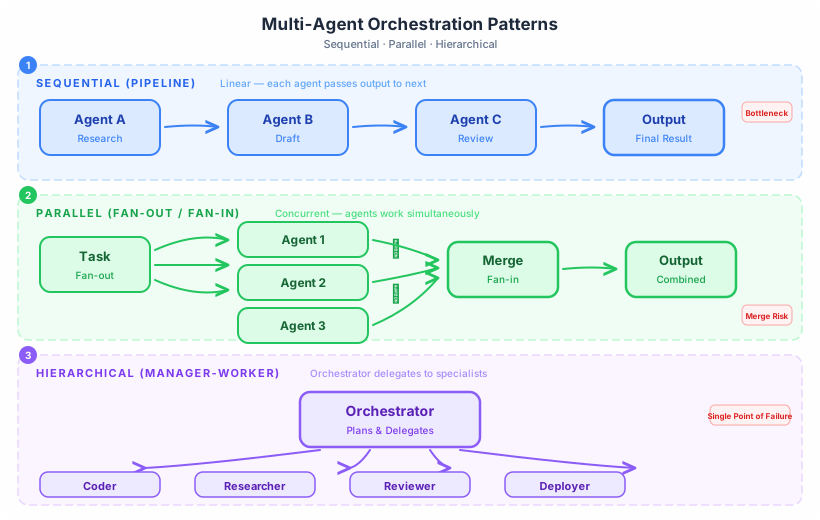
Three primary patterns determine how agents collaborate:
| Pattern | How it works | Best for | Risk |
|---|---|---|---|
| Sequential (Pipeline) | Agent A passes output to Agent B, then Agent C | Linear workflows (research, draft, review) | Bottleneck: one failure blocks everything |
| Parallel (Fan-out/Fan-in) | Multiple agents work simultaneously, results are merged | Independent sub-tasks (analyze 5 competitors at once) | Inconsistent outputs when merging |
| Hierarchical (Manager-Worker) | Orchestrator agent delegates to specialists | Complex tasks with dynamic planning | Single point of failure at orchestrator |
Graph-based orchestration (e.g., via LangGraph) is not a separate fourth pattern but an implementation method for the three patterns above: agents form a directed graph with conditions, loops, and dynamic routing.
Framework Landscape (since 2025)
Section titled “Framework Landscape (since 2025)”| Framework | Approach | Strength | Best Fit |
|---|---|---|---|
| LangGraph | Graph-based state machines | Maximum control, compliance | Enterprise, mission-critical |
| CrewAI | Role-driven crews | Simple mental model, rapid prototyping | Content pipelines, team simulations |
| AutoGen (Microsoft) | Event-driven multi-agent (since v0.4) | Async execution, human-in-the-loop | Research, complex reasoning |
| OpenAI Agents SDK | Lightweight handoffs | Simple agent-to-agent handoffs | OpenAI ecosystem products |
| Claude Agent SDK | Tool-use with agentic loops | Deep tool integration, MCP-native | Complex agentic applications |
When Multi-Agent Makes Sense
Section titled “When Multi-Agent Makes Sense”Multi-agent is justified when: sub-tasks are naturally separable, require different tools or permissions, benefit from parallel execution, or need different trust boundaries.
Single-agent is better when: the task is linear and coherent, context sharing between steps is critical, latency matters more than thoroughness, or debugging simplicity is a priority.
Framework
Section titled “Framework”The Multi-Agent Decision Ladder — work through from top to bottom:
| Step | Question | Result |
|---|---|---|
| 1 | Can a single agent with good tools solve this? | Yes: use single agent |
| 2 | Are sub-tasks naturally independent? | Yes: consider parallel multi-agent |
| 3 | Do sub-tasks require different tools/permissions? | Yes: consider specialized agents |
| 4 | Is the workflow linear with clear stages? | Yes: sequential pipeline |
| 5 | Does the task require dynamic planning? | Yes: hierarchical with orchestrator |
| 6 | Always: start with 2-3 agents max | Add complexity only with evidence |
Scenario
Section titled “Scenario”You’re a PM at a B2B SaaS company. Your product is a content marketing platform. The team wants to build an AI content workflow:
- Research Agent — analyzes trends and competitor content (needs web access)
- Writer Agent — creates articles based on research (needs brand guidelines)
- SEO Agent — optimizes for search engines (needs SEO tools)
- Editor Agent — checks quality and facts (needs fact-checking tools)
- Publisher Agent — formats and publishes (needs CMS access)
The engineering team estimates 8 weeks of development for the 5-agent pipeline. A single agent with all tools would take 3 weeks. Your current manual pipeline takes 4 hours per article with 3 people.
The question: 5 agents, 1 agent, or a compromise?
Decide
Section titled “Decide”How would you decide?
The best decision: Start with 2-3 agents, not 5. Specifically: one Research+Writer agent (they share a lot of context) and one Review+Publish agent (they share quality gates). SEO optimization as a tool, not a separate agent.
Why:
- Research and writing need maximum context transfer — an agent boundary between them loses nuance
- SEO is a tool call (check keyword density, generate meta tags), not its own reasoning loop
- 3 weeks for 1 agent vs. 8 for 5 — start with 2-3 in ~5 weeks and validate
- End-to-end reliability with 2 agents (95% each): 90%. With 5 agents: 77%
What many get wrong: Creating a separate agent for every step in the manual process. Human division of labor doesn’t map 1:1 to agent architecture — agents can handle multiple roles but need shared context.
Reflect
Section titled “Reflect”Multi-agent systems solve real problems — but the first question must always be: is a single agent actually failing at this task?
- Every agent boundary is a place where context is lost and errors multiply
- Framework choice (LangGraph, CrewAI, etc.) is rarely the differentiator — prompts, tools, and data are
- Start small: 2-3 agents maximum, add complexity only with evidence
Sources: Adopt AI — Multi-Agent Frameworks (2025), Turing — AI Agent Frameworks (2026), DEV Community — LangGraph vs CrewAI vs AutoGen (2026)